Used to be Marketing focused. Now just using this as a place for friendly discussion and education. The main purpose is to cultivate our ability to see things from someone else's perspective. We find meaning in ourselves, by searching for meaning in the world around us.
Well, I missed my daily blog yesterday. But it was for a good cause, catching up with Drew Hisey and Billy Restey, good friends and owners of Dystnct Media.
It's such a pleasure to come back to Seattle and see friends doing so well (personally and professionally). The guys have a fantastic work studio with a view of the water in downtown Seattle including beautiful handmade wooden desks that Drew's dad crafted giving it an authentic PNW feel.
I thought it would be fun to take a look back at the first project Drew and I worked on together before showing you Dystnct's 2015 reel. Not just to show you how far he's come, but because the night hold's such a special place in my heart. Time is flying and it's crazy to think that this video from Freaknight was from 2011. Almost 4 years ago! It's also symbolic for me as I'm preparing to re-enter the world of video with a full head of steam.
Not a bad video for 2011 right?! I'd challenge anyone to find a more cohesive, well edited video of a rave from 2011. The soundtrack was also a song from local Seattle producers so it was a Seattle production through and through.
If you liked the video above, prepare to be blow away with what I'm going to share next. Things really started to take off when Drew and Billy teamed up, between the two of them there's nothing they can't handle. Video production, motion graphics animation, product design, graphic design...I'm continually blown away by the quality of the work they're doing and the breadth of projects they're able to take on successfully. So without further ado, enjoy the Dystnct Media 2015 showreel:
I applied for a writing job today and they asked for a 300 word sample. It took me more time than I'd like to admit because I've gotten into such a nice flow of writing for myself this past two weeks that I had to remember to follow the guidelines. I think I started over completely twice. Which in retrospect isn't that bad, it's just not something I run into very often with blogging. But it was fun to feel the pressure again. There is something deep within me that changes when I have a time constraint. I could say it forces me to find the right words, but it's more of a pulling feeling. A lack of control, yet total control at the same time.
As I mentioned earlier, it doesn't always get done in one go (there's something wrong with you if you don't review your own work and tear it to shreds a few times) but when the words finally fall into place, you can feel it.
Don't get too excited, it's just 300 words on coffee :)
Here were the guidelines:
Topic: How to make your favorite coffee/tea
Audience: Someone looking for a new kind of coffee/tea
Key points to cover: What is your favorite coffee/tea, how to choose, how to make it, pros/cons of this approach. Length: 300 words.
Voice and tone guidelines:
Honest: Sensitive but not sappy, responsive but not alarmist.
Direct: To the point. Strive for clarity and directness by not adding complexity or unnecessary commentary (i.e. fluff).
Confident: Professional but not formal. Never sarcastic. Speak with authority, but be open to other opinions.
Accessible: Conversational but not intimate. Use plain language, but don’t erase technical language completely or talk down--we educate instead.
***
Sizzling hot or ice cold, it doesn’t matter what season it is, one thing remains true: Americans love
coffee. According to a recent study by the National Coffee Association we drink over 382 million
cups a day!
So how do you take your coffee?
Chances are you’re looking to switch things up. You’re aware of the many amazing health
benefits coffee provides, but you also realize that popular drinks like the Caramel Mocha
Frappuccino can contain upwards of 600 calories per serving. For those of you looking for a
new way to take your coffee, I have a radical new suggestion: black.
Not only is it the simplest and quickest way to take your coffee, it’s the healthiest. A new study
called the “2015 dietary guidelines” released by the FDA states that 3-5 cups of coffee a day are
okay, as long as you don’t add cream, milk, or sugar.
If you don’t like the taste of black coffee making the switch could be difficult, it’s an acquired
taste. I would suggest starting off with iced coffee. Not only is it drinkable year round, you can
have your barista add a half an ounce of nonfat milk and toss in a few Splenda’s for flavoring.
Just be sure you don’t go overboard, the whole point is to slowly but surely ween yourself off of
all the artificial sweeteners and calorie dense milk. For those of you that shudder at the thought
of iced coffee, attempt to engage your sense of smell when sipping your morning Joe. Slow sips
and careful appreciation for the smell of the roasted beans will make each sip go down easier
as you feel the caffeine hit your system in a way that only black coffee can.
Something I wrote a while back :) ....Still useful info...
I mean facebook a tweet, no! Tweet a facebook post?
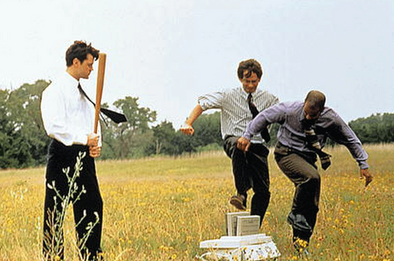
Technology is amazing, but I’m sure we’ve all felt like the 3 guys from Office space at one time or another.
Managing your organizations social media account can feel like a shot in the dark sometimes, confusing and time consuming. Unless you are a recent college graduate, you probably don’t have any formal social media training. If you’re in the advertising/marketing industry you probably have a basic understanding of the functionalities and capabilities that are available to you on facebook and twitter (due to your personal use). You might even use facebook chat as the primary tool of in-office communication. Which might sound crazy to some, but many agencies actually do.
The goal of this post is to give you some insight into how about how consumers are posting/interacting differently on facebook vs. Twitter in order to facilitate the different types of communication that have established by each social network.
The primary difference between facebook and Twitter is that facebook acts as a community or hub for constant brand presence in the form of a conversation. Facebook has a past, for those who like to reminisce over old pictures, a present, where engaging content is exchanged in return for consumer attention (their precious time), and a future, undefined and open to innovation. As Brain Solis puts it, “Facebook allows for richer, more interactive experiences hosted within the confines of a branded and captive environment.” This means that you have the opportunity to engage in a more complex in-depth conversation with people than you would on twitter. This does not mean your status updates should be longer, it means the experience itself should spark interaction and communication between fans, not even necessarily between the fan and the brand. I am a firm believer in the idea that everyone has a story they want to share and they are just looking for the right platform to share it on. Make your page, something they obviously have some kind of emotional attachment to or passion about, a place for them to open up and tell their stories. Learn to facilitate conversation, don’t speak AT people. (Studies show that statuses with 80 or less characters have the highest engagement….Don’t believe me? Take a look at Redbull’s posts)
Twitter is the pulse of business; it gauges your real-time relevance with consumers and helps to keep your brand top of mind. More importantly, it allows you to listen and respond to conversations about your brand or industry. We’ll get into more detail about how to spike engagement on twitter later, but for right now, a good question to ask yourself before you tweet is: Would I find this tweet useful? Entertaining? Interesting? If not…don’t tweet it
Advances in technology have made it easier than ever to communicate with more people than ever. Yet there is no specific road map for social media success, so your success with these new tools for communication will still depend on social science and your ability to decipher YOUR customers social media behavior.
Many of you probably recognize the man in this slightly disturbing photo.
Good, I’m glad it got you attention. If you guessed Rainn Wilson, also know as Dwight on the office, you are correct. I stumbled across this photo earlier today when I stumbled across a new tool for twitter called “Twylah” (which I believe is pronounced Twhy-la). Rainn, along with many others, is one of the celebrities that has begun using this Twitter-aggregating, message-making, brand page organizer. It is still in an early roll out phase, and you must request an invite if you wish to join, but it looks like the product might turn out to be an extremely useful way to turn your tweets into a story-telling web page. I highly recommend watching the video below.
Some of the things Twylah can help you with:
-Bring your message into focus: Automatically organized by your trending topics, Twylah pages show the world who you are and what you’re about at a glance.
-Take your tweets beyond Twitter: Your tweets last about an hour on Twitter. Give your tweets much greater exposure and a significantly longer life.
-Own your tweets and traffic: Host your Twylah pages on your domain and own the content and traffic.
Brain Solisrecently posted the transcript from an interview he did with Capital Magazine on his blog about the rise of Generation-C, or “Generation-Connected”. Brain explains how the rise of this new generation has changed the way we craft our media strategies, and how businesses must decide when and where to use social vs traditional media. (Check out the interview here)
This new generation of connected users is unbound by demographics and exists in a constantly evolving digital world. Relying heavily on mobile and tablet platforms as their window to the world, Generation-C is shaping the way that businesses interact with, and most importantly, treat their customers online. In short, these online customers demand the same treatment online as off. Creating customer-centric social strategies that deliver an engaging interactive experience, beginning to end, is necessary to developing meaningful Generation-C relationships that garner support and loyalty; ultimately, leading to sales.
All of a sudden, companies who’ve never had to deal with answering their customer’s dissatisfactions directly are being called out via social media. They’ve been forced to join in on the social conversation and treat their customers with the respect and attention they deserve, or be left behind. It no longer matters if your product is tangible because Social Media visibility has become a benchmark for brand legitimacy. One user left a comment on Brain’s interview that I feel describes the Generation-C perspective perfectly: “If there are no reviews, no FB page, and no Twitter account, I am less likely to trust the product and company. It’s as if they are hiding.” No Trust, no purchase.
Social media has equaled the playing field by taking a large portion of brand perception out of the marketers control; delivering your marketing message is no longer a one-way street. In order to regain control over that message, marketers must now create genuine interactions between the consumer and the brand. Starting to sound like a service industry isn’t it. Every company from small diner to large corporation can be publicly criticized or praised on the Internet. And unlike conversation between friends, once something is on the Internet…it’s there for good. Word of mouth marketing will always be one of the most powerful forms of marketing, and for Generation-C, social media is just an extension of WOM into the digital sphere of their lives.
Social media matters, it’s a great way to communicate with customers and monitor the conversation around your brand; but it is not replacing traditional media. Your new job, based on how your customers consume different types of media, is deciding how to balance the two and create an effective strategy. This can be difficult, so in our next blog, we’ll go into detail about the differences between different social media channels how you should utilize them.
Mircosoft made a ton of noise yesterday about their impending announcement that will take place on Monday June 18th in Los Angeles. It only took a few more hours for the story to leak that their announcement will most likely be about the release of a new tablet they’ve been developing. The quote that’s been floating around the internet goes a little like this: “[An] individual with knowledge of the company said that Microsoft would introduce a…tablet at the event…put[ting] the company in direct competition with giant rival Apple.” Along with rumors of a new Mircosoft Office Suite and the tablet carrying Windows 8, we at Two Twelve Direct have come to a conclusion.
Our conclusion is not about what Mircosoft is going to say at their big conference on Monday, rather, about how they are saying it now. Give Mircosoft credit for their Apple-like attempt at creating a story around the release of this new product. It’s no secret to those in the marketing world that everything Apple does around a new release is planned down to the very last detail, even the ”accidental” leaving of a iphone prototype in a coffee shop (the first time!).
An iPad Killer! Killer, what a buzz word! And most likely thought up by someone in marketing at Mircosoft and then leaked to a blogger. But that’s ok! That’s what they are supposed to do! It means Mircosoft is on the right track. They know they need to create interest in their new product by creating a story around its awesome power to defeat, nay, slay the evil Apple iPad. As we have mentioned in previous posts, the success of this product will ultimately depend on design, an area where Apple has consistently out-witted them. Functionality/technology is not main factor in the American consumers purchase decision any longer. referring to this new undescribed product as an iPad Killer was an amazing idea because just using the word “iPad” evokes feelings of great design. This leads us to believe that the only way this new product could “kill” the real iPad is by having a way cooler, simpler, design and user interface.
Either way, Mircosoft figured out that it was going to need a lot more than the product specs to create genuine interest in a new tablet and took their main competitor head on. We aren’t sure anyone can “kill” the iPad, but we definitely want to see how this story plays out, and we bet you do to.
This is my first post, and also the first paper I had to write for my Com 460: mass media criticism class. It is a semiotic analysis of the opening scene to Showtime's Dexter. My professor limited us to two pages so its not too extensive, but I feel like it touches on some important points. It is also my first attempt so go easy on me! Hopefully you enjoy this and it gives you a sense of what my writing style is like.
Slicing, dicing, and ever so enticing. The opening to Showtime’s Emmy award-winning Dexter is filled with misconstruing symbols making it ripe for semiotic analysis. Even though the scenes that combine to create the opening are a representation of a man going through his morning routine, the message that is actually conveyed is extremely different depending on ones interpretation of the symbols they are viewing.
Lets dig deeper. In language we use words to represent concepts once they are aggregated into sentences. These words are separate entities that come together, interact, and create understanding between those who speak the language or understand the codes being used (Berger). “The essential break through of semiotics is that it takes linguistics as a model and applies linguistic concepts to other phenomena, texts, not just language itself” (Berger, 5-6). Therefore, it is easy to see why many of the signifiers in the opening of Dexter not only represent their denotation but also have malicious bellicose connotations; leading the audience to completely different signifieds, or concepts, based on their interpretation. It is in this way that specific signifiers can result in different signifieds for people when viewing any kind of text, sometimes resulting in confusion for the audience. The opening to Dexter has no dialogue or spoken words and is set to a creepy little ditty that makes his actions even creepier. But like Arthur Berger said, “It is obvious, then, that people are speaking all the time, even when they aren’t saying anything verbally” (Berger, 15)
For example, in part of the opening scene there is a shot at close range showing a rope wrapped around both of a mans hands that suddenly pull and visibly tighten making the area around the ropes on his hands turn white. This brief scene, when analyzed intertextually, conveys the sign to be the act of strangling to most people who have seen strangling scenes in previous texts and understand the code being used. When in reality, once the scene comes to an end it is clear that the signifier and signified combine to produce the sign of a man tying his shoes in the morning. The signifier of drops of blood from Dexters shaving accident, to the slow motion and graphic slicing of his grapefruit which he then juices and leaves to resemble distorted flesh. Many of the shots in the opening scene of Dexter use visuals set in a syntagmic relationship that immediately conveys one sign, or connotation, to the audience, and then switch it instantly to show the true denotation that the visual symbols are interacting to create; and all of them insinuate murder.
The very first shot in the opening scene shows a mosquito sucking blood out of Dexter’s arm that he then slaps and kills and the audience see’s a smile spread across his face. The signifier and the signified of Dexter slapping his arm and then smiling convey something very different to different audiences. For one that has never watched the show they might follow the denotative thought that killing a mosquito is good. When in reality, for those who watch the show and know the codes being used know that connotatively, waking up and killing anything, is a great start to Dexter’s day.
All in all, the opening to Showtime’s Dexter is a magnificent composition of signifiers and signifieds that move and change rapidly to convey different signs that must be decoded semiotically by a knowledgeable audience that speaks the language. It just goes to show the true brilliance behind the ability of the directors to use symbolic metonymies to create malevolent connotations out of a denotatively peaceful routine.
Bibliography
Berger, Arthur Asa. Media Analysis Techniques. Thousand Oaks, CA: Sage, 2005. Print.
Seiler, Robert M. "Semiology // Semiotics." Reading. Upload & Share
PowerPoint Presentations and Documents. 1 Mar. 2010. Web. 08 Sept. 2010. .